
 Thoughts + Podcasts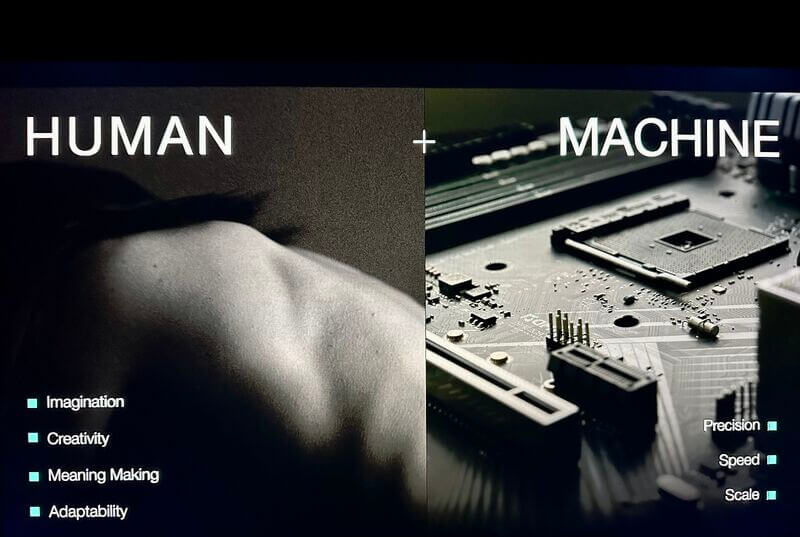
Jack · 5/6/2026
Being MORE Human in the Age of AI
The Human Edge: Being More Human in the Age of AI
Everyone is talking about AI.
Mostly with fear.
Job loss. Layoffs. Uncertainty. The sense that something large is moving toward us and we're not sure where to stand.
Last week I was having coffee with a C-suite executive at a top 10 global private equity firm. We were deep in a conversation about AI implementation across her portfolio companies when she stopped, put her coffee down, and said:
"We should be talking more about the human side."
She's right. And that's exactly where I'm focused.
While Everyone Is Watching the Machine
The conversation around AI has been dominated by what the technology can do — and what it will take. That's a real conversation worth having. But it's incomplete.
Because underneath all of it, something quieter is happening.
The role of the human is being rewritten.
Not eliminated. Rewritten.
Machines are absorbing precision — the analytical, repetitive, high-volume work that used to fill our days. And what's left isn't less work. It's different work. Work that requires something machines can't replicate, at least not yet: judgment, discernment, creativity, genuine human connection.
The fear makes sense. But it's pointed at the wrong thing.
The question isn't whether AI will change your work. It will. The question is whether you understand what's actually increasing in value — and whether you're developing it.
For Executives: You're Not Implementing AI. You're Redefining What Your People Are For.
Most executive conversations I'm in right now are focused on the mechanics — which tools, which vendors, which workflows to automate.
That's the wrong level of the conversation.
When you bring AI into an organization, you're not just changing how work gets done. You're changing what humans in that organization are responsible for. What they're there to do. What leadership actually means at every level.
Leadership is shifting. And here's what I believe: everyone who creates impact is a leader. Not just the people at the top of the org chart. The new question for executives isn't how to manage headcount through a technology transition. It's how to develop the human capacity — judgment, clarity, discernment — that becomes more valuable as machines take on more of the load.
That's the work. And most organizations aren't having that conversation yet.
For Founders: Your Product Isn't Just What the Machine Does. It's What It Forces the Human to Become.
Founders are in a unique position right now.
You're building in a moment where the technology is accelerating faster than most people can track. But the most important design question isn't about the machine. It's about the human on the other side of it.
What does your product ask of the person using it? What does it demand from them? What does it make possible — not just in terms of output, but in terms of who they become in the process of using it?
That's a different kind of product thinking. And founders who get there early have a chance to lead differently — not just building faster or cheaper, but building in a way that actually develops the humans in the system.
That's a real edge. And it matters more than most people realize.
What's Actually Rising in Value
Speed and accuracy? Machines won that.
What's increasing in value — what no model can fully replicate — is this:
Clarity. The ability to cut through noise, name what's true, and communicate it cleanly.
Judgment. Knowing what matters, when to act, and when to wait — with incomplete information and real stakes.
Creativity. Not just generating ideas, but shaping them. Knowing the difference between something interesting and something that actually works.
Relationships. Real ones. Built on trust, presence, and the kind of understanding that takes time and attention to develop.
These aren't soft skills. They're the hard skills of the next era.
The Invitation
The age of AI isn't asking you to become less human.
It's asking you to become more fully human — to develop the capacities that have always mattered most, but that got crowded out by work that a machine can now do better.
That's not a loss. That's a release.
The executives and founders I work with who are moving well through this moment aren't the ones with the best AI tools. They're the ones who understand what they uniquely bring — and who are intentionally developing it.
That's The Human Edge.
And it's the most important thing to be building right now.
JS coaches and advises executives and founders navigating leadership in the age of AI. If this resonated, follow along or reach out directly.
